Monday, May 3, 2021

Skittles and All Her Kittens

March 2006

In the spring of 2003, Isaac and I went to a little house north of Hopkinsville. A lady was giving away kittens from a litter of five. The kittens were in a big box in her living room. We wanted a female kitten so Happy, our old tom, wouldn't feel obligated to fight with it. 

There were two little females. One trembled in fear when touched, and the other reached her paw to Isaac and then bit him. Isaac decided that the little biter had personality, so we brought her home and named her Skittles. 

Skittles is spayed now, but she had two litters of kittens when she was a mere adolescent.  During one of the kitten episodes, the babies had grown too large for their box in the house. The weather was warm, so I moved them to a large wooden box on the carport. 

 I glanced into the box one afternoon, and I was shocked to see a fuzzy little alien in there. The kittens were nursing, and a baby rabbit was huddled against them. Obviously, Skittles had acquired the rabbit, and she didn't seem interested in eating it, so I left it there. I didn't know if it would survive if I released it, and I hoped that maybe it would accept Skittles as its mother. 

I looked in the box the next morning, and I was shocked to see that now there were two little rabbits. I surmise that in her condition of activated maternal hormones, Skittles decided the little wild rabbits were actually kittens who needed a home. Never mind that their ears were a bit long; obviously they needed her care.

 I still wasn't sure what to do with the rabbits. They were so young that I was afraid they'd die if I turned them loose. Still, I wondered about leaving them with Skittles. She groomed them enthusiastically, just as she did her feline children but I didn't ever see the rabbits nursing. She wouldn't have minded, but they didn't seem interested. 

After much pondering of the situation, I sought out a recipe for homemade milk-replacer for rabbits on the internet and bought some pet bottles so we could feed the little rabbits by hand. They were flighty, slippery little creatures, but they were hungry. Keely named them Abbot and Costello, and developed a method of wrapping them gently in a towel for feeding. That way, they could shrink into the towel rather than darting forward if they were startled. 

Unfortunately, Abbot died, and then we had just Costello to nurse along. I read that rabbits have fragile bones and I became concerned about the kittens hurting him. They were much larger and they played roughly. We decided to move Costello to a nest of dry grass clippings in the bottom of a large round garbage can in the house. 

Costello was terribly nervous whenever we handled him. He couldn't help it; that's the way little wild rabbits are. I think he became about as tame as a little wild rabbit can be. Sometimes as he drank his bottle, he closed his little eyes and seemed to enjoy it and maybe even dozed a little as I sat very still and held him, bundled in his little feeding towel. 

Soon Costello developed sharp teeth that could sever a pet bottle nipple with a single chomp. I started giving his milk to him in a drinking bottle designed for hamster and rat cages. It had a long metal tube with a metal marble in the end of it. Costello quickly learned to push the marble up just enough that a trickle of milk flowed out of the tube into his mouth. He grew rapidly. 

Soon our little rabbit developed a hearty appetite for clover picked from the lawn for him, and I knew that he could probably survive on his own. One sunny day, I took him out to the hedgerow along the back fence where there was a thick cover of unmowed vegetation, and I said goodby to the little guy. After I released him, he sat still for a moment and then crept away into the tall grass. I couldn't help worrying about him! 

Meanwhile, the kittens had grown too large for the wooden box, so we had moved them to a 6-foot round cattle tank that the kids had used as a pool when they were little. One day, I saw Skittles jump into the tank with a baby squirrel struggling in her mouth. Apparently she had an idea of adopting it like she had done with the rabbits. 

The little squirrel was trying so hard to escape that Skittles was excited by it. She seemed a bit uncertain -- was it a baby or was it a game animal after all? I snatched the wild little thing away from her. It leaped from my hands in a flash, ran into the shrubbery and was never seen again. Skittles was momentarily puzzled where the strange baby had gone -- and then she nursed the kittens. 

Last summer, when Costello would have been one year old, an unusually tame rabbit lived in our yard. He didn't come close to us, but he never ran away or froze in position like rabbits do when frightened. He was quite comfortable even at a 15-foot distance. The lawn mower didn't disturb him much; he just moved out of its way and enjoyed the freshly mowed greens. 

We saw him all summer long, placidly grazing on the clover in one spot or another. Of course we think it was Costello.

Hoping for a Snow Day

 March 2006

As I took Isaac to school this morning, he was hoping for enough snow that school would be cancelled. It brought to mind a silly little thing I said when I was in 2nd or 3rd grade, about this time of the year.

School had been let out for the day, and we students (all seven or eight of us) spilled out of the little schoolhouse with our lunchboxes in hand. It was windy and chilly, and the sky was almost colorless. I announced to the Horner girls in a voice of authority, "Look at that sky! It looks like we'll be getting some snow tonight."

In truth, I wasn't sure what the sky looked like when snow was imminent, but I had heard my dad say things like that, and it sounded good when I said it.

It sounded good because we children liked snow and plenty of it! We hoped for heavy snow so our teacher would cancel school for the day. The snow had to be deep because if the teacher thought she could even get close to the school, she'd call someone on the school board to meet her with a tractor and get her through the drifts to the schoolhouse.

Every chore in ranch life was made a hundred times more difficult when there was heavy snow, so our parents always hoped that it wouldn't snow just as hard as we hoped that it would.

Struggles of an Amateur Pianist

March 2006

God in His wisdom has planned that we don't have many musicians in our church. We do have a very good organist who serves faithfully. When he can't be there, our pastor usually can get a substitute organist, a lady from Clarksville who plays beautifully. But if this lady can't come, Pastor calls me and asks if I will play the piano.

I am not a good pianist by any stretch of the imagination. I had piano lessons when I was growing up, but my talent was never more than mediocre. I have no inborn gift for reading music. It has always been hard labor for me. Similarly, I am not particularly good at reading time -- dotted notes, rests, and such. I struggle terribly with unfamiliar music! Sometimes I even photocopy music and use white-out to remove notes that confuse me.

When I have to play for a church service, I often have trouble with one or two of the hymns. I practice dilligently, but when it's time to play them in public, sometimes I do OK and sometimes I make mistakes. But whatever notes I hit, right or wrong, I play on, the congregation sings on, and soon enough we come to the end. 

Over time, I've had a couple of insights about playing for church. I have learned that several other ladies in our church play the piano a little. I would be happy to let any of them play in my stead, but no one else has ever volunteered. That must mean that they would rather endure my efforts than try it themselves.

More importantly, I realized a while back that nervousness is a self-centered emotion. The piano is part of the music, and the music is part of all the worship that is offered to God during the church service. Obsessing about my fears and imperfections is wrong; I should play the best I can, and God will bless the music. I try to keep that in mind.

Tonight I have to play for the Lenten service. Pastor called me yesterday afternoon and since then, I've been practicing. The hymns are "Jesus, Thy Boundless Love To Me" with the Vater Unser melody, "O Dearest Jesus", "There is a Green Hill Far Away", and "Go My Children With My Blessing".

In our hymnal, the first two hymns are one difficult minor chord after another, but I found easier arrangements in another hymnal. If I concentrate on reading the notes, I should do all right on them. The other two are easy enough. A short prelude, the four hymns, the offertory, and a short postlude, and I'll be done. Yes, I feel a little nervous, but I'll be OK.

Friday, October 23, 2020

This is the Way We Wash The Clothes

 March 2006

Oh, the virtue of it all. The laundry is washed, dried, folded, and put away. I'm free from that drudgery for a few days until it piles up again. But at least, I have a washer and a dryer. I'm grateful for them! 

We bought our first washer and dryer shortly before Keely was born. A fellow who was moving sold us the set cheap. It was apartment-sized --the washer hooked up to the sink faucet, and both the washer and the dryer could be plugged into ordinary wall outlets. It was wonderful not to have to drag the laundry to the laundromat anymore.

Then we went to Germany for five years and our washer and dryer went into storage. When we came to Kentucky, the little washer refused to wake from its long hibernation. It wasn't worth fixing, so we went to Sears and bought a Kenmore washing machine which served us faithfully for 15 years with only a couple of visits by the repairman. 

Though its mate died, the apartment-sized dryer still worked when we came back to Kentucky. We used it for about a year, until one day I put too much heavy wet clothing into it and burned up its motor and the wall outlet it was plugged into. 

I had already rigged a clothesline between a couple of trees, so I dried the laundry outside for the next five years. Money was tight and a dryer wasn't an absolute necessity. I soon became well acquainted with the joys and frustrations of depending on a clothesline.

Clothing dried outside usually has a wonderful fresh-air scent. However, there were times when our neighbor spread manure in his field, and any clothing hung out to dry picked up the stench. And while laundry dried quickly on a warm, breezy day, it didn't dry at all in rainy weather.

Hanging the clothes was a pleasant outdoor diversion on a warm day, but on a winter day, even with gloves, my hands ached with cold before a full basket of wet laundry was pinned to the line. 

Dennis decided that the clothesline between the trees looked tacky, so he fixed a proper clothesline with metal poles, on the south side of the house where the north wind wouldn't be so bitter in cold weather. That turned out to be a bad idea. We have a wood stove that we use in the winter, and in the clothesline's new location, the laundry picked up a strong smoke smell all winter.

We eventually got a dryer (a Kenmore.) I'm grateful for it, but I still hang clothing outside sometimes when the weather is nice. I don't have a clothesline anymore, but I do have a chain that I use for clothing on hangers -- one hanger per link in the chain. The hangers can't slide together and the wind can't blow them off the chain. If I put the clothing on hangers as soon as the washer stops, most of it dries nearly as wrinkle-free as if it had gone through the dryer. 

My Mennonite neighbor, Kathryn, is dedicated to hanging her laundry outside on the clothesline year-round, though she has a dryer for emergencies and long rainy spells. Her clothesline is a long loop strung around a pulley on each end. One pulley is on the porch and the other is mounted high on a tall pole far across the yard. She stands on her porch to pin on the clothes, then pulls the line through the pulleys to move the clothing out into the air high above the yard.

Last year, the Kenmore washer started having some problems and we decided to get a new washer. I researched washing machines in the $500 range, and finally decided on a General Electric with a stainless steel basket. I am satisfied with it; my only complaint is that it is noisier than the Kenmore. 

My conclusions about all this? A washer and a clothesline are better than going to the laundromat, and a washer, a dryer and a clothesline are as good as doing your own laundry can be. But a laundry maid would be the best of all.

Thursday, October 8, 2020

Ink Bottles and Fountain Pens


I attended Duff Valley District 4 in Rock County, Nebraska in the late 50s and early 60s. It was a one-room elementary school with a pitcher pump, a flagpole, a swing set, outhouses, an old barn from the days when the students rode horses to school, and of course, the schoolhouse itself.

The desks in our schoolhouse were old enough that most of them had inkwells built into the upper right corner of the desk top. An inkwell is a cup that holds a bottle of ink and keep it from spilling while a writer is using it. 

Ball point pens had been invented by then, but writing with real ink wasn't  completely obsolete. Stores still sold little bottles of ink and the necessary ink pens. One variety of pen had an inner rubber bladder that held a supply of ink.  This was an innovation that allowed the pen to write for a while before it needed refilling.  The user filled the bladder by dunking the pen in the ink bottle and operating a little lever on the side of the pen. The filling procedure made a small interesting gurgle. 

I was never able to keep my hands clean while messing around with an ink bottle and pen. Sometimes there were spills. I made a big black ink mess on a page in my Social Studies book during my ownership of one manually loaded ink pen. I accomplished this behind the privacy shield of my raised desk lid because my teacher had already told me to stop playing with my pen and ink. 

I enjoyed fountain pens, too. A fountain pen got its ink from a plastic cartridge that was a little smaller in size than a triple-A battery. An ink cartridge was installed by pressing the pointed top end of the pen's nib into one end of it and loading the cartridge-with-nib into the body of the pen. 

The ink cartridges almost always leaked at the puncture point. The ink oozed onto the grip of the pen, and soon my writing fingers had black, red, blue, or green stains, depending on the color of ink in the cartridge.  

If I accidentally let the pen rest against the paper when I wasn't writing, an ink spot quickly developed. If I shook the pen, little drops of ink flew from it.  If I thoughtlessly rested my hand or arm on the wet ink, it smeared, and if I folded the paper before the ink was dry, it made mirror images of any wet letters. These things happened with both types of ink pens.

We students made plenty of messes with ink, but Duff Valley's teachers had a long history of ink accidents that they couldn't deny. The bottoms of the wooden drawers in the teacher's desk had dozens of blots and stains from decades of leaky ink pens and tipped-over ink bottles. 

Isaac's Strep Dream

March 2006

Isaac was home from school yesterday because he has strep throat. Last night in his medicated and somewhat feverish condition, he had a nightmare. In his dream, he had invited his friends to a party in our yard, and a crowd was gathering. 

Meanwhile, everything inside the house was terribly wrong. Dennis was sitting at the table in his underwear drinking beer. Keely and I were dressed in the ragged old clothes that we save for painting. The house was a total wreck, nothing was ready for the party, and no one but Isaac seemed to care. 

People were showing up that I had invited without consulting Isaac, and they were people he didn't like. He didn't even know some of the people I had invited, including the goth-looking teenage couple we saw at the library yesterday afternoon (in real life.) 

Isaac was frantically trying to fix everything, but there were too many things that were very badly wrong and he knew he was going to be terribly, terribly embarrassed at any moment when his friends came inside.

 The classic nightmare with the "Darn, I forgot to wear my clothes!" moment seems almost mild compared to the kind of humiliation that the family was inflicting on Isaac in this dream.

I have wild dreams at times, but I rarely remember them long enough to tell anyone about them or even think about them. But Dennis, Keely, and Isaac dream vividly and often entertain me with the curious plots their minds create.

Wednesday, September 9, 2020

Wintery Night

February 2006

The rain of yesterday afternoon changed to snow when night fell. The ground was still warm enough to melt most of the flakes as they fell, so the snow didn't accumulate much. Isaac was hoping that the roads would be icy or that we'd get enough snow for school to be cancelled. But school in Christian County was "in session and on time" this morning.

Dennis went to work in the wee hours of the morning. He called me at 6:30 AM to say, "Careful!" He said that he came across some slick spots while driving to Fort Campbell.

South of Pembroke, he met a man walking toward him on the highway. He thought that was odd, but he didn't stop because he was going in the opposite direction of the walker.

Down the road a little farther, he saw blipping lights that turned out to be a volunteer fireman's pickup truck, stopped along the road. The good fireman (God bless him and all his kind!) was checking a car that had gone in the ditch.

Dennis stopped and told the fireman that he had met a man walking and that the man did not appear to be hurt. The fireman got out his cell phone to call the highway patrol, and Dennis went on to work.

All of that happened in the middle of the night while most of us were asleep. I didn't even have a bad dream, but that guy who was walking down the road probably thought he was having a nightmare.

Snowman With Hat

February, 2006


We rarely get a snow in Christian County, KY, that is just right for building snowmen. Keely and Isaac built this handsome fellow in 1994. My goodness. Isaac was only four then, and Keely was eight! Keely tells me that the snowman's hat was the ice from a cat water dish.

Tuesday, September 8, 2020

A Pileated Woodpecker Sighting

February 2006

Coming up the lane to our house this morning, Isaac and I saw a pileated woodpecker. He left a tree in the ditch, flew across the road in front of us, and landed on the side of a tree in Clarence's woods. He was quite a large bird. In fact, when the woodpecker took to the air, Isaac said, "What is that? A duck?"

We had a fairly good look at him. I'm certain that he was a pileated woodpecker, not a red-bellied or a red-headed woodpecker. I checked the range map for woodpeckers, and it's possible a pileated would be overwintering or even breeding in this area. It was a great thrill to see a pileated woodpecker for the first time ever!

This was the only pileated woodpecker I've ever seen anywhere!

Nursery Rhymes

February 2006

Daffy Down Dilly
Has come up to town
In a yellow petticoat
And a green gown.

Remember that one? When my children were little, I read nursery rhyme books nearly every day. This rhyme and many others gradually worked their way into my long-term memory banks.

I remember being in the tiny kitchen in one of our apartments in Germany. I was washing dishes, but Keely wanted me to read to her. She sat down on the floor with her nursery rhyme books, and I recited the rhymes to her from memory as she turned the pages.

The kids had a big library of storybooks, but the nursery rhyme books were always some of my favorites.

Grandma Nora's Basement Apartment

February 2006

My dad's parents (Grandma Nora and Gramp Hill, as we called them) divorced in about 1947. During my childhood, Grandma lived mostly in Ainsworth, Nebraska, but Gramp Hill lived in Missouri and then in Kansas.

Grandma Nora and Gramp Hill had a house in town, and it became Grandma Nora's after their divorce. She made it into two apartments. She rented out the ground floor, and she lived in the basement apartment. It was interesting, even exciting, to visit there because we didn't have a basement and besides, it was Grandma's house!

Looking back, I realize that the decor was very 1950's. Grandma had a dining table and chairs, a china cabinet, and a little writing desk that were all made of blonde maple. In her living room, she had cowboy lamps. The lamp base was shaped like a wagon wheel, and the lampshades had photographs on them of cowboys on horseback tending their cattle under a bright blue sky. Grandma had a matched set of smaller lamps, as I recall, and a larger lamp with a two tiered shade. All three of them had the western lampshades.

Grandma also had a gumdrop tree made of clear plastic. It had a gumdrop on the tip of every branch and extra gumdrops in the tray under the tree.

Grandma's renters had some things in the basement storeroom, including a big stack of MAD magazines. I read them every time we visited, taking great pains not to bend the pages. That was my introduction to Alfred E. Neuman.

One time, my little sister Charlotte and I spent the night at Grandma's basement apartment. Grandma tucked us into the twin beds in her guest bedroom -- one little girl in each bed. During the night, Charlotte woke up and became frightened. She cried, " I want my daddy, I want my daddy!" and soon Grandma came and took her to sleep in the big bed. In her later years, Grandma liked to tell that story. It pleased her that Charlotte had cried for her daddy -- he was Grandma's son, of course.

Grocery Store Music

February 2006

When I was a teenager, Mama and I were walking around a grocery store one day. A big band song was playing, and I made a derogatory remark about "grocery store music". Mama looked at me and laughed and said, "Oh, is that what it is?!" (That sort of music was popular when Mama graduated high school in 1940.) 

Now I'm in my mid-50's, and I notice that many of the stores are playing my music. I hear the Beatles all the time, the Beach Boys too, and many others. The other day when I was in the fabric store, Bob Dylan was on the muzak. (He never could carry a tune, bless his heart.) "That's Bob Dylan,"I said to the lady who was cutting my fabric. "Huh? Oh, really?" she said. I think she grew up before Bob Dylan. She looked more like a Bing Crosby and Frank Sinatra person. 

 The Peddler's Mall flea market in Hopkinsville always plays music of the 1950's, mostly rock-and-roll. It's very cheerful. The toetapping rhythms put me in the right mood for looking at all that old junk in there. I'm sure that's what the mall owners have in mind.

Saturday, September 5, 2020

I Like Hats

February 2006

When I was about 4 years old, I spent a few days with Grandma Barb and Gramp Sees (as we called him.) Grandma Barb took me to town and bought me a beautiful little hat. It was round and flat, made of white straw, with a ring of white daisies around the crown and long ribbon tails that hung down the back. 

I wore it on the train when I went home. Three other little children were traveling without adults, and the conductor assigned us to a set of facing seats. I suppose my hat was uncomfortable against the back of the seat. Anyway, I took it off, and one of the little boys sat on it and squished it. He also sat on my lunch bag and squished my marshmallow-top cookie! I still feel irritated, all these years later.

In the days of my early childhood (the 1950's) all the ladies wore hats to church. I especially remember the hats of Mrs. James Tapley, our pastor's wife, at the Church of the Nazarene in Ainsworth, Nebraska. She was young and pretty, and she had a hat for every outfit. One of her hats had a bumblebee hovering over a flower. I was enchanted with it. 

Even after hats were no longer de rigeur, my mother still kept several black hats which she wore to funerals.

I have a small collection of hats. I bought a couple of them at yard sales because they were pretty. They needed to be owned by someone who appreciated them. I wore one of them at Halloween last year and told people that it was my costume.

Thursday, September 3, 2020

Windmill Song

February 2006

Settlers of the Great Plains often found that water was harder to get at their new homes than where they used to live. To solve this problem, inventors re-imagined wooden windmills as water pumpers for the Midwest. 

Instead of the giant wheels of Holland's windmills, the American windmills had a smaller wheel of wooden blades that turned to catch the wind. These machines could easily pump water from deep wells. The windmill rapidly became an essential piece of agricultural equipment and a key to a better life in the Midwest. 

The Aermotor, brought to market in the late 1880's, was one of the first all-steel windmills. With a revolutionary set of gears and a carefully engineered ability to respond to the slightest puff of wind, the Aermotor was a reliable and popular machine. It is still manufactured today.

 Dempster was another major windmill manufacturer, and there were many others. Windmills made by the hundreds of competitors in the windmill business can still be seen and enjoyed in the collections of Nebraska towns, museums, and individuals.

In old images of Nebraska, I notice that many citizens of Nebraska's small towns had windmills in their backyards, even into the 1930's and 1940's.

Every ranch child of the Nebraska Sandhills has the windmill's song embedded in his memory. It's a repetitive melody with the tempo set by the wind, a creak and a groan as the mill turns and the sucker rod moves, and an alternating gush and trickle as the water pours out. It was the soundtrack of my childhood.

As the windmill pumped, the fresh, cold water poured out of a horizontal pipe that extended a couple of feet beyond the edge of the stock tank. To get a thirst-quenching drink, we cupped our hands under the water flow and leaned over the tank to drink from them.  It was best not to drink at the moment in the pump cycle with the strongest gush of water from the pipe. That could instantly fill a nose with water.

The overflow from the water tank almost always created a windmill pond. The tank and pond supported a wetlands flora and fauna greatly different from the surrounding landscape. Waterbirds chirped around the edges of the pond. Frogs sang, and dragonflies hovered above the water. 

We had a windmill in the greater yard around our house, barn, and other buildings. Its tank was positioned to provide water to cattle on both sides of a fence that divided two pastures. My sister and I spent hours in my childhood, making aquariums in a quart jar with snails and moss from the windmill tank, and playing around the windmill pond. On a hot day, getting a bit wet was a bonus.

Grandpa Harry Sees had goldfish in the big wooden windmill tank in his barnyard. I think they were large, but probably not as monstrously huge as they seemed when I was little

By the 1960s, electric pumps had taken the place of windmills in the farmlands of Iowa and Illinois. My father had a small business in rebuilt windmill motors from Iowa. He became acquainted with a retired plumber from central Iowa. This fellow drove around Iowa's farmlands, purchasing unused windmills to restore. His son climbed the old windmill towers and helped him get the motors down. He preferred Aermotors, but he occasionally bought Dempsters, too. 

When the rebuilder in Iowa had a batch of windmill motors ready, my dad took the pickup and trailer and hauled them home. I think he advertised them in the local paper at times, but mostly, the neighbors all knew that if they had windmill trouble, Charlie Hill probably had a good rebuilt motor on hand that he would sell them at a reasonable price.

Now sun power is beginning to replace wind power. Solar panels can run a pump, and ranchers don't have to climb a windmill tower to service them. The windmills of the Nebraska Sandhills may fall into disrepair and disuse, just as they did in Iowa and Illinois a few generations ago. 

Life with Well Water

February 2006

The water for our house, here in rural Christian County, KY, comes from an old hand-dug well. It's about 3 feet across and 30 or 35 feet deep, and it is lined with big limestone building stones. It was probably dug in the early 1800s, or maybe even earlier.

When we first moved out here, the well was protected only by a piece of roofing metal laid across it. We were afraid the kids would fall into it! We put a fence around it immediately, and very soon thereafter, built a little house over it, installed a strong metal grid across the mouth of the well, and moved the water pump from our laundry room to the well-house.

To get a good well in this area, it's necessary to hit a water vein in the limestone that underlies the soil. Our Mennonite neighbor Willis brought a pocket watch on a chain one day and used it as a pendulum to dowse the water vein that our well is on. He says it is a minor channel of water but it connects to a larger channel 100 yards away.

Having our own well is an exercise in self-reliance. We don't have a monthly water bill and we don't depend on a public utility. If worse came to worst, we could drop a bucket into our well and get water. However, there are inconveniences. 

  • When the electricity goes out, we can't pump water, so we store several 5-gallon containers of water for such emergencies.
  • When temperatures fall below freezing and we're worried about ice forming in the pump, we turn on a light in the well-house.
  •  Silt seeps into the well when we have heavy rains, so we have a water filter in the well-house that has to be maintained.
  •  We usually buy our drinking water, but if we must drink well water, we add 8 drops of chlorine per gallon.
  •  In dry weather, we use water conservatively so we don't pump the well dry! 

Today Dennis had trouble changing the water filter. As he tried to loosen and remove the old filter, a pipe joint suddenly popped a leak. That was the first problem. The second problem was that Dennis somehow cracked a section of PVC pipe while attempting to fix the leak. 

We called a plumber and paid him to come out and fix the whole shebang. The way things were going, it seemed the sensible thing to do.

Marcus and Emma Eaton, Homesteaders

February 2006
Marcus and Emma (Hart) Eaton

About 1899, my great grandparents, Marcus and Emma (Hart) Eaton, came from Marshalltown, Iowa, with their daughters Cora and Violet (my maternal grandmother), and homesteaded in the Lavaca area of Cherry County, Nebraska. 

With a population of 20 (according to the Nebraska State Gazetteer, Business Directory and Farmers List for 1890-1891,) Lavaca was the Sandhill version of a post-hamlet.  It had 2 blacksmiths and a general merchandise store that probably doubled as a post office, as well as a school and probably a church or two. It was located about 25 miles southwest of Merriman on the extreme western edge of Cherry County.  The Lavaca Flats lie alongside the Niobrara River. It's an area of level land with good meadows, and nowadays, some center-pivot irrigated farmland. 

According to the 1886 map of the Fremont, Elkhorn & Missouri Valley Railroad. a rail line ran through Valentine and Gordon and on to Douglas, Wyoming. The Homestead Office was in Valentine. Marcus and Emma probably rode the train as far as Merriman, but I have read about people who got off the train at Valentine and walked many miles through the sandhills to their homesteads.

During their years at Lavaca, Marcus and Emma added two more daughters to their family, Almira and Letha. Marcus drove the twice-weekly stage to Gordon, and was a road overseer for the Lavaca precinct, as well as farming his homestead.

As the girls grew up, Marcus and Emma wanted them to have a high school education. They sold their homestead in about 1912 and moved to Gordon.* There, the three younger girls completed high school, and Marcus operated a livery stable. Marcus was a farm boy, and he had worked as a teamster in Marshalltown before they came to Lavaca. He knew a lot about horses.

Emma died in 1929, and in 1931, Marcus lost his daughter, Violet (Eaton) Sees to influenza. Marcus visited his widowed son-in-law Harry Sees and his granddaughter, Doris (my mother) frequently after Violet's death.  Doris described Grandpa Eaton as a tidy, well-groomed fellow. Both she and her cousin Maxine Young (daughter of Letha Eaton Young) had fond memories an all-day trip with Grandpa Eaton in his car to visit Wounded Knee, just across the South Dakota line from Sheridan County, Nebraska. 
  
Marcus and Emma are buried in the Gordon, Nebraska city cemetery, adjacent to the graves of Violet Eaton Sees, Harry Sees, and Harry's second wife, Barbara Weber Sees. The Eaton graves were unmarked for many decades, but in 2014, my brother, Dwight Hill (a great-grandson,) had a tombstone installed.

When I was a little girl, my mother pointed out a certain frame building in Gordon as her Grandpa Eaton's livery stable. The building had big doors -- beyond that, I don't remember much about it. When I was in Gordon with Keely and Isaac in 2000, I tried to relocate it, but I learned that it had been torn down.  

One other thing of interest about my great-grandfather Marcus Eaton -- he remembered that as a little boy in Marshall County, Iowa, he played in the buffalo wallows on the prairie.

* In about 1917-1920, Violet Eaton returned to Lavaca as a schoolteacher. While Violet was teaching there and boarding with a school family, she had the memorable experience of discovering a mouse inside her nightgown after she had put it on and gone to bed. (Good family stories should be recorded and retold.) In 1940-42, my mother (Doris Sees Hill) taught in the same Lavaca school. As part of her contract, she was given a horse to ride to school. Some in the community remembered both her mother (Violet) and her grandparents (Marcus and Emma.)

Emma (Hart) Eaton was born in Polk County, Iowa, 06 Feb 1865, and died 19 Apr 1929 in Gordon, Sheridan County, Nebraska. Marcus Eaton was born in Marshall County, Iowa, 13 Sep 1861, and died 03 Jul 1942 in Gordon, Sheridan County, Nebraska. Marcus and Emma were married on 19 Nov 1889, in Mitchell, Davison County, South Dakota.

Turkey Buzzard Stories

February 2006

 We have a lot of buzzards (also called vultures) in western Kentucky. When we first moved out here in the Kentucky countryside, the barns in the field east of us were standing empty. Buzzards roosted on the roof ridges nearly every summer night. They flew in at sunset, and as darkness fell, they cooed to each other with their vulture voices.

An amusing thing happened several years ago. We have a local landmark known as Pilot Rock. It's a big shaft of rock that juts up out of the hills and towers above everything else in the area. A lady about my age had grown up here and moved away. She came home to visit and decided to climb Pilot Rock, for old times sake. 

When she came back down, she told everyone about her peaceful experience on top of the Rock. "Oh!" she said. "It was so quiet up there!" She told us how she lay down and stretched out and watched the clouds floating by and the vultures circling in the sky. Her brother was horrified. "Good grief! You won't catch ME lying on the ground for long with vultures circling over me!"

Several years ago, the Kentucky New Era (our local newspaper) published a photographic essay about autumn at Pilot Rock. The photography girl had driven out and taken a few pictures of trees in their fall colors. In the text that described the pictures, she stated that there wasn't any life stirring except a dozen big hawks circling the skies. Ha! Everyone out here laughed about that. We all knew she had seen vultures, not hawks. 

A couple of weeks later we laughed again when the newspaper published a letter that someone from another state had written. He stated that he was certain the photographer had seen vultures, not hawks.

Most or all of our vultures here in western Kentucky are Turkey Buzzards. They are beautiful in the sky, riding the wind with their wings spread wide. Sometimes people mistake them for eagles, but eagles can be up to one-third larger than buzzards.

Tuesday, September 1, 2020

Counting the Dead Ones

February 2006

I've enjoyed online forums ever since we got a computer and the internet. I've especially enjoyed reading the Ranchers.net Bull Session Forum. Most of its members are cattle ranchers, and most of their conversations and photographs center on the joys and difficulties of ranch work and raising cattle.

I have some knowledge of ranching because I grew up on a Nebraska cattle ranch. My brother and sister-in-law still ranch in south-central Kansas. However, a lot of what I know about ranching is at least a generation old. Things have changed a lot since I was a ranch girl, and ranchers are using new methods and tools. Even on the most remote of ranches, technology advances and knowledge increases.

Some things don't change much, though! I'm reminded of that when I see photos of cows and their newborn calves in the springtime.

Seeing a picture of a mama cow and her baby makes me think of being a little girl, taking a ride through the pasture with my Daddy to check the cows and calves in the springtime. He always referred to those trips through the pasture as "counting the dead ones", which was his way of saying that he was braced for the worst, though hoping for the best.

Be Prepared

February 2006

The Boy Scouts take a lot of ribbing about their motto, "Be Prepared," but the truth is that boys who have been through the Scouting program are better prepared than many of their peers to confront and overcome difficult circumstances.

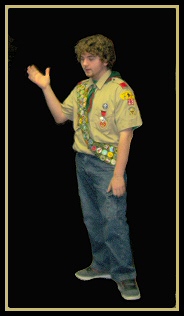
Here is my favorite Boy Scout, my son Isaac, at his troop's Court of Honor in December. He's speaking to the group. (I didn't like all the backs of heads that were in the picture, so I edited everything out except Isaac.)

I admire Isaac's ability to pitch a tent fast, but that's only a small part of what he's learned in Scouts. He has earned merit badges (worn on his green sash) in everything from automotives to woodcarving, and just as importantly, he has had many opportunities to develop leadership skills.

We have a great Scoutmaster, a retired Special Forces Army officer, who has taught the boys all about wilderness survival and map and compass navigation. He has both exemplified and taught the Scout Law along the way. Dennis has been active in Boy Scouts with Isaac, and it has been a wholesome and meaningful activity for the two of them to share.

Memorable Methodist Experience

February 2006

We have lived in Christian County, Kentucky, for about 15 years, and in that time, I have been in the First Methodist Church of Hopkinsville twice.

A young man from our church (Greg) belonged to the Boy Scout troop that First Methodist Church sponsors. We went to his Eagle Scout ceremony, and that was the only time I've been in the FMC sanctuary. I think I remember dark wood pews.

My other visit to the First Methodist Church was much more memorable. Not long after we moved here, I applied for a job as a teacher in the pre-school at First Methodist. They ran an ad in the newspaper, and I sent a letter and got an interview.

The day of the interview came, and I dressed up and went to the church. Two very proper ladies met me at the rear entrance. They showed me around the pre-school and explained the program. During the tour, it became clear to me that I was probably not the person they were looking for. Then they announced that they were taking me to a church luncheon that was currently underway, and that we'd eat lunch while they interviewed me.

We sat at a small round table with our plates of food, surrounded by dozens of people at their own little tables, all talking loudly. I was very uncomfortable under the scrutiny of my interviewers/lunchmates. It wasn't easy shouting answers to their questions about my philosophy of preschool education between tiny bites of food. I didn't want to be caught with my mouth full, and I was doing most of the talking. All the while I became more and more certain that I absolutely did not want the job.

Finally the meal and the questions ended. We shook hands, and I walked out the back door and across the parking lot. I felt weakened after my horrible ordeal. An involuntary shudder came across me, and I groaned mightily with mortification and anguish.

At that moment, I heard a voice from behind me ask, "Are you all right?", and it was one of my interviewers who (unbeknownst to me) was walking behind me to her car. "Oh, yes," I chirped. "I'm just fine."

I don't know whom they hired as their new pre-school teacher, but it was not the woman they overheard making Chewbacca noises in the parking lot after her interview.